|
www.santeerefugefriends.org
Friends Invite You
to Come to Santee NW Refuge
"The
best birding center in South Carolina and
the Southeast."
Santee
NW Refuge 2125 Fort Watson Rd.
Summerton, SC 29148
803-478-2217 West of I-95, exit
102 @ US 301/US 15, 6 miles south of Summerton,
SC
"When one tugs at
a single thing in nature, he finds it attached
to the rest of the world" - John Muir
|
Menu:
Become a Member
Events - Future
Events - Past
and history of Santee Friends
Directions to
Santee National Wildlife Refuge
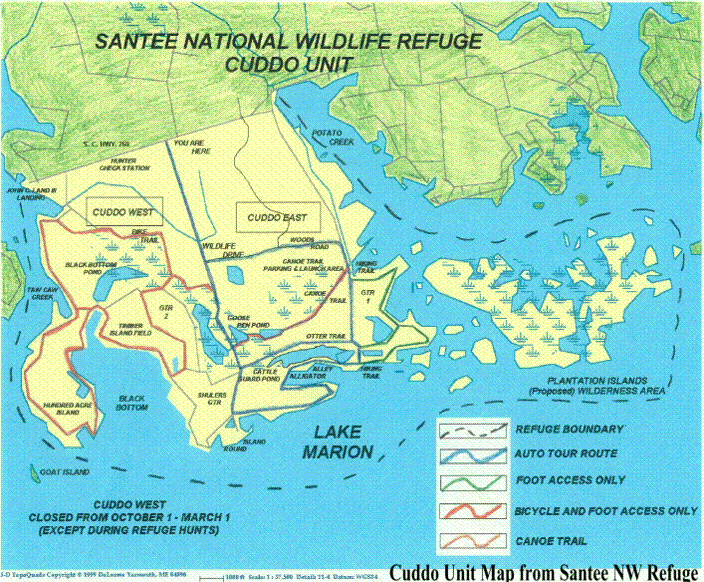
Map of Santee
NW Refuge - Cuddo Unit
Bird List
|
 The purpose
of the Friends of Santee National Wildlife Refuge
The purpose
of the Friends of Santee National Wildlife Refuge
is to promote conservation, awareness, and appreciation
of the
Santee National Wildlife Refuge
and to provide assistance
to the Refuge programs in welcoming visitors
to Santee NW Refuge.
|
|
|
|
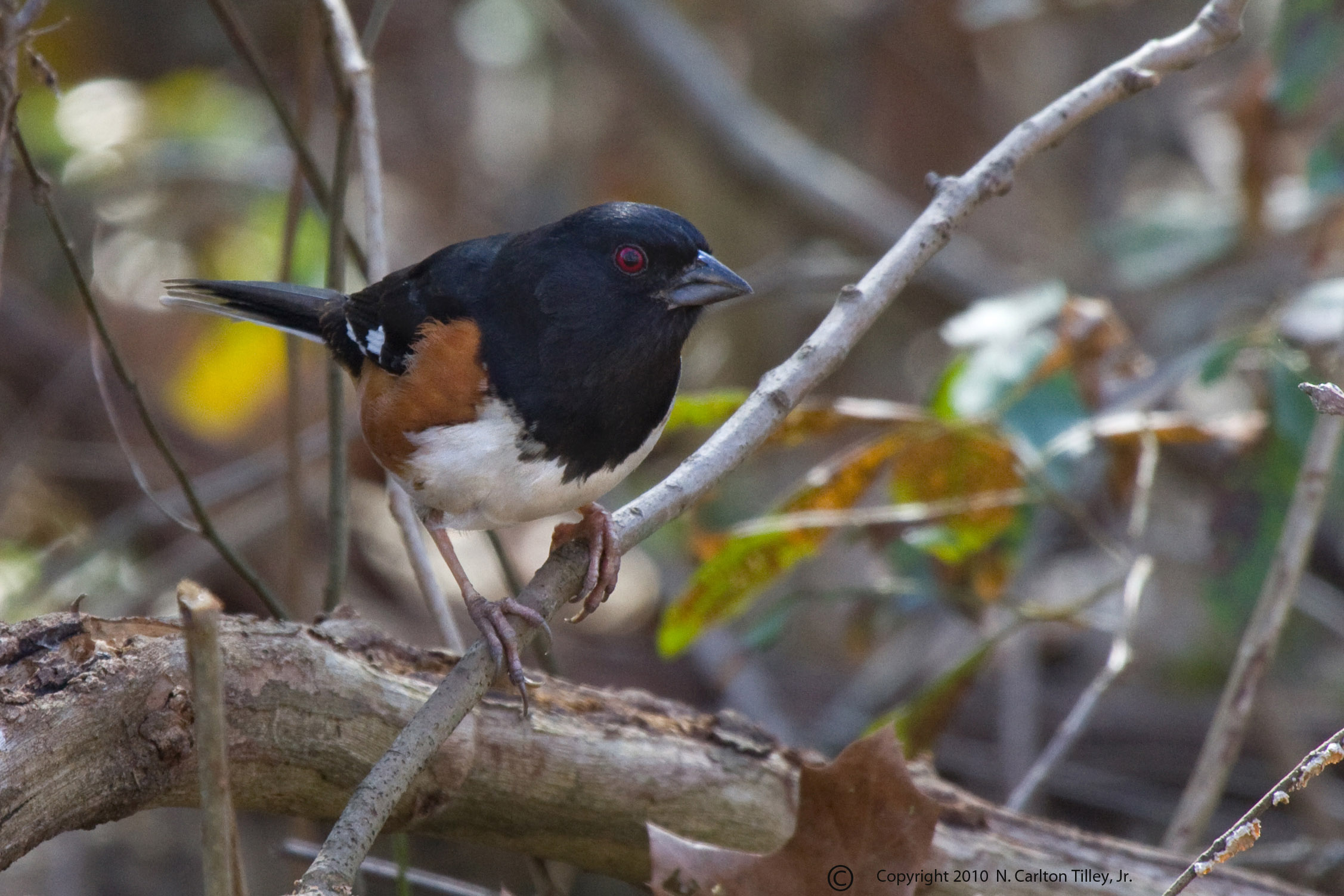 Capture a glimpse of some of South Carolina's residents
like this Eastern Towhee during bird walks offered at Santee NWR this month
(Credit: Woody Tilley) Refuge Announces May
Events:
Capture a glimpse of some of South Carolina's residents
like this Eastern Towhee during bird walks offered at Santee NWR this month
(Credit: Woody Tilley) Refuge Announces May
Events:
Come out and connect with nature at Santee National Wildlife Refuge this
month. May is a beautiful time of year to bring your family or enjoy
the solitude you can find on one of the refuge’s hiking trails or along
the Wildlife Drive. The Visitor Center is a great place to start and
find out information about what’s being seen around the refuge, including
the best places to view such beautiful songbirds as the Painted Bunting and
Prothonotary Warblers or for a possible glimpse of an American Alligator
or many of the refuge’s other reptilian residents.
To celebrate International Migratory Bird Day, the refuge is planning bird
walks to help visitors learn about bird-watching in South Carolina and the
refuge. Participants should meet at the refuge visitor center located
off of Ft. Watson Road, 7 miles south of Summerton off Hwy 15/301.
The tours will begin at 7:00 am and will last approximately 2 hours.
Please contact refuge Park Ranger, Susan Heisey at 803-478-2217 for information
or directions on where to meet. The bird walks are scheduled for:
Tuesday May 17th and Wednesday May 18th
Tuesday May 24th and Wednesday 25th
National Wildlife Refuges…Where Wildlife Comes Naturally!
|
|
|
|
Visitor Center Schedule • Normal
hours of operation are Tuesday through Friday, and the first
Saturday of each month from 8:00AM – 4:00PM. We recommend calling
ahead to ensure the center will be open (803-478-2217).
CLOSED On Sundays and
Mondays
|
|
|
|
Fishing
on the Refuge:
All areas open to boating are also open
to fishing, as well as the Scott's Lake Public Fishing Beach.
These areas produce largemouth bass, catfish and bream. All Federal
and State regulations are in effect. For more information, contact
the refuge.
|
|
Posted on Fri, Sep.
28, 2007 TheState.com
"Off
the beaten trail" Cuddo bike path in Santee refuge
a great place to check out wildlife
By JOEY HOLLEMAN - jholleman@thestate.com
It’s more a dirt road than a
bike trail, and the knee-high grass makes pedaling a
bike difficult in some sections.
Despite those drawbacks, the
critter-filled surroundings on the banks of Lake Marion
make the 8.7-mile bike trail through the Cuddo Unit of the
Santee National Wildlife Refuge worth the trip.
Usually, spotting wildlife while
riding a bike is nearly impossible. On a nearly two-hour
ride in Cuddo, I saw some large gators on land and in the
water, two deer, a great blue heron, several great egrets, a wide
variety of ducks and so many butterflies that at times I felt
the need to slow down so they wouldn’t smack me in the face.
Other sections of the 15,095-acre
preserve in Clarendon County have plenty of hiking trails,
but Cuddo has the refuge’s only trail designated for bikes.
(Hiking is allowed on the bike trail.) Unlike the main office of
the Santee Refuge, which is just a couple miles from I-95, you have
to travel several miles on back roads to get to the Cuddo Unit entrance.
The gate is open 7 a.m.-7 p.m.
April through September and 8 a.m.-5 p.m. October through
February. The Cuddo Unit is closed to hikers and bikers during
two deer hunts Sept. 30-Oct. 6 and Oct. 15-20.
The rest of the year, Cuddo is
all about wildlife viewing. I stopped three times on
my bike trip to take photos. A bird-watcher with more patience
might want to stop 10 times, especially when cooler nights take
the sting out of the bug population.
It’s obvious the refuge staff
spends more time worrying about resident wildlife than
human visitors. The bike trail is nothing more than a dirt
road used sparingly by refuge workers and, for two weeks a year,
hunters.
The dearth of trail markers prompted
me to go against Robert Frost’s advice and take the road
more traveled whenever there was a choice. Only once did
that fail me. Near the end of the clockwise loop, I went straight
when I should have turned right. But 100 yards down the wrong
road, I came upon a “dead end” sign and turned around.
The trail winds through a basic
pine/immature hardwood forest. The first must-stop spot
is a couple of miles into the journey when only the trail/road
separates Lake Marion from a pond.
Two large gators sunbathed on
an island in the pond. What looked like large moving sticks
in the lake cove meant at least a half-dozen more gators hang
out in the area. The Cuddo Unit has the highest concentration
of gators, and the largest individuals, in the refuge.
If you encounter a gator sunbathing
on the bike trail, you’d best turn around and try the loop
going the other direction.
I made it only a few hundred
yards more before leaving the bike behind to stroll on
the clam-covered shore of the drought-sunken lake. Back on
the bike, what had been an easy ride turned difficult when the
dirt road gave way to thick grass. I bet no more than a dozen bikes
had cut through that grass in the past couple of months.
The tall, thick grass, which
dominated two of the next three miles, made the bike
seem like it had two flat tires. This would be an ideal section
for a Lowcountry biker training for long, uphill climbs.
In the middle of the grassy section
is the other hard-to-resist stop on a point between two
lake coves. Small cypress trees spike the broad lake vista. On
this sunny day, yellow and purple wildflowers blanketed the edges
of the road, and the flocks of butterflies made it seem many of the
yellow flowers had sprung wings.
After another mile of grassy
road and one brief wrong turn, the final mile or two
back to the car was an easy pedal. Just for kicks, I drove the
full 7.5-mile auto trail in Cuddo, which reminded me why it’s
much more interesting to hike or bike, even if you have to plow through
tall grass.
Reach Holleman at (803) 771-8366.
BIKE RIDE: A place to ride
at the Santee National Wildlife Refuge WHAT: 8.7-mile
bike trail
WHERE: Cuddo Unit of the Santee
National Wildlife Refuge
WHEN: 7 a.m.-7 p.m. April through
September; 8 a.m.-5 p.m. October through February. Closed
to hikers and bikers during deer hunts Sept. 30-Oct. 6 and
Oct. 15-20.
DIRECTIONS FROM COLUMBIA: Take
I-26 east to I-95 north. Get off at exit 108. Turn right,
and go about 1½ miles to the end of road. Turn left,
and go 2 miles to Davis Crossroads. Just past the crossroads,
take the first paved road to the right and go about 4 miles. Turn
right and go about ½ mile until road dead-ends. Turn right,
and the entrance to the Cuddo Unit is on the left. Refuge signs
make it easier than it seems.
FEES: Free
INFORMATION: (803) 478-2217 or www.fws.gov/santee
|
|
Come to Santee NW Refuge
and join for 2009.
Friends of Santee
National Wildlife Refuge
invite you to join or
renew your membership for 2009.
|
Student
$10
Individual
$25
Family
$40
Patron
$100
Sponsor
$250
Corporate $500
|
The purposes of Santee Refuge Friends
are exclusively charitable and educational within the
meaning of the Section 501 © (3) of the Internal
Revenue Code of 1954 and is an independent, non-profit
organization.
|
|
|
|
Designation:
"Important Bird Area"
by National Audubon Society
Based on: endangered
species, watch list species and concentrations
of birds
(waterfowl, colonial
waterbeds and exceptional numbers of migratory
land birds).
|
|
|

|
Become a Member
|
|
Santee Refuge Recognized
as an Important Bird Area by Audubon
Friends of Santee National Wildlife
Refuge announced that the National Audubon Society
had conferred the designation of "Important Bird Area"
(IBA) upon Santee National Wildlife Refuge.
This announcement was made at the conclusion
of International Migratory Bird Day activities
held on the refuge on Saturday, May 15th, 2004.
Santee National Wildlife Refuge was selected as
an Important Bird Area on the basis of
three nominating criteria: Endangered
Species, WatchList Species, and Concentrations
of Birds (waterfowl, colonial waterbirds, and exceptional
number of migratory landbirds). Quoting
from Paul Koehler, Audubon's coordinator for South
Carolina's Important Bird Area Program, "I applaud
the management and conservation efforts at Santee NWR
that contribute toward it being named an Important
Bird Area". There are now 30 IBA's that
have been recognized in South Carolina and nearly
1,500 across the United States. Congratulations
to the refuge staff on this special recognition.
Two signs designating Santee NWR as an Important
Bird Area are erected at visitor contact areas
to help underscore the importance of the refuge
for bird populations.
|
Santee National Wildlife
Refuge Migratory Waterfowl Ground Census:
Species:
|
1-6-09
|
12-12-08
|
11-26-08
|
1-17-07
|
Hooded
Merganser
|
2
|
2
|
10
|
30
|
Mallard
|
1315
|
312
|
501
|
1525
|
American
Black Duck
|
62
|
20
|
22
|
145
|
Gadwall
|
310
|
40
|
7
|
385
|
American
Wigeon
|
840
|
120
|
12
|
136
|
Green-winged
Teal
|
2964
|
1020
|
912
|
1900
|
Northern
Shoveler
|
140
|
10
|
0
|
40
|
Northern
Pintail
|
22
|
7
|
0
|
22
|
Wood Duck
|
612
|
2580
|
2883
|
1775
|
Lesser
Scaup
|
0
|
20
|
2
|
30
|
Ring-necked
Duck
|
1737
|
750
|
330
|
3950
|
Canada
Goose
|
1180
|
710
|
504
|
1032
|
Tundra
Swan
|
0
|
0
|
0
|
4
|
American
Coot
|
44
|
85
|
100
|
750
|
Pied-billed
Grebe
|
0
|
0
|
0
|
78
|
Bufflehead
|
3
|
0
|
8
|
0
|
Canvasback
|
12
|
0
|
0
|
0
|
Blue-winged
Teal
|
120
|
0
|
0
|
0
|
Totals
|
9363
|
5680
|
5381
|
11802
|
|
Come walk the new nature trails
between the Visitor
Center and Indian Mound.
|
|
New Binoculars at the Visitor
Center,
thanks to Friends and Santee
Cooper.
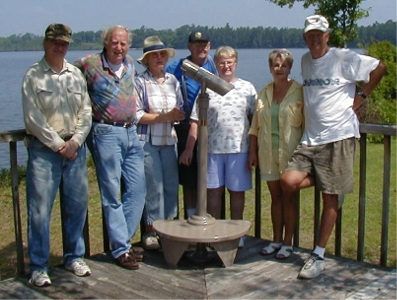
New Binoculars
in place & dedicated Oct 16, 2004.
Visitors on
the deck have increased 30%.
Thank you Santee
Cooper for your donation.
We are working hard to increase
membership and to get members involved with
proposed projects on the Refuge.
If you
have a special skill or interest please let
us know.
|
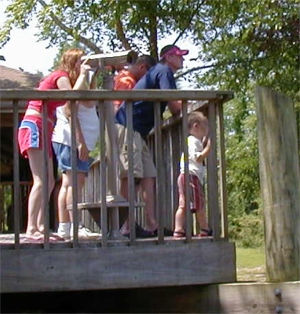
First visitors
to use the new glasses, June 19, 2004.
|
|
New Refuge System Exhibit Panels at SC Welcome Center
Two new exhibit panels promoting
the Refuge System, the Centennial
celebration, and inviting travels to visit
the refuges located near Interstate 95 were
erected at the SC Welcome Center and Rest Area
sites just across Lake Marion. The panels
which are housed in covered, outdoor kiosks also
include a section devoted to Santee National Wildlife Refuge.
Several hundred
thousand travelers on I-95 could view
these panels annually.
|
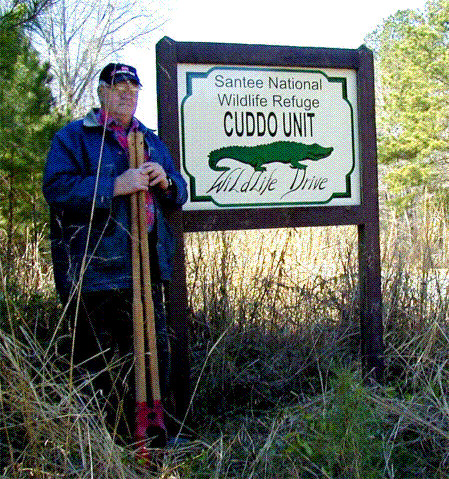
Find the Cuddo
Driving Trail with the new sign installed
by Gene; revised in 2010, look for new sign.
|
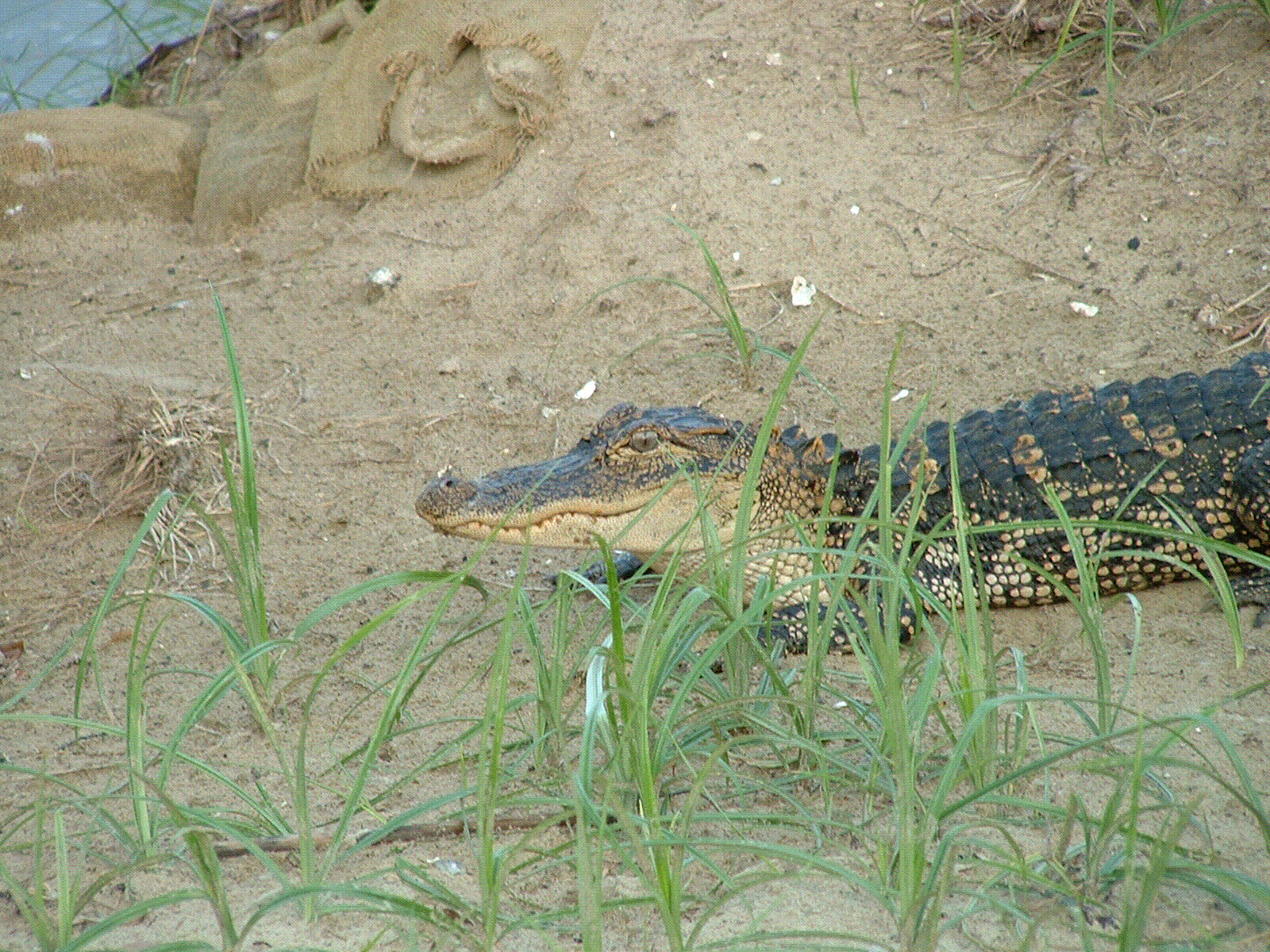
Young spring
gator seen in Cuddo, 2004.
|
|